- Home
- How Things Work
- Electricity
- Ohm's law
Ohm's law
The one short rule that ties together push, flow and resistance.
The short version
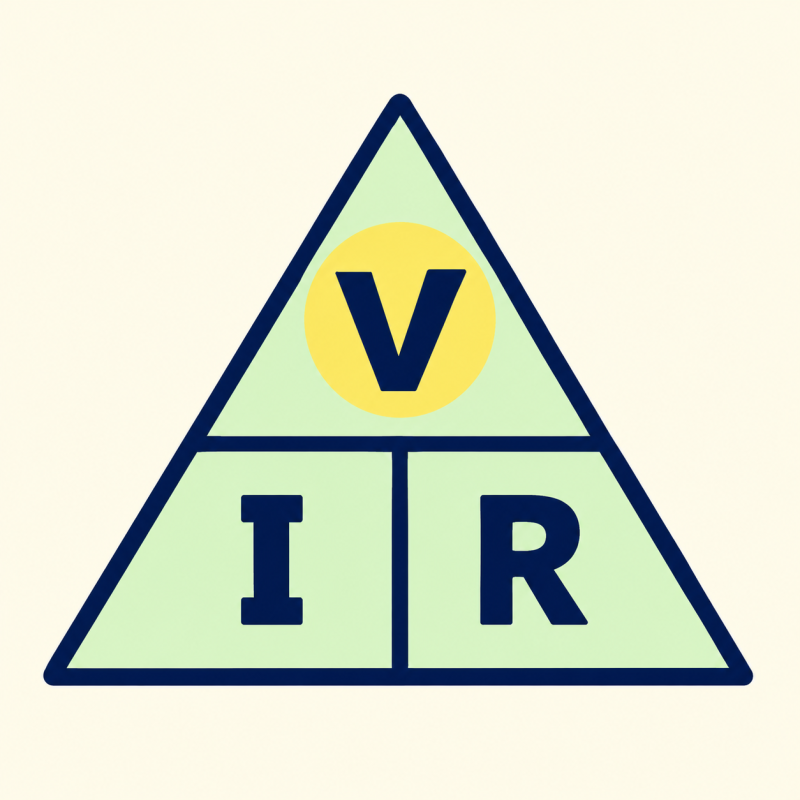
Ohm's law says that the voltage across something equals the current through it multiplied by its resistance. Written as a formula, V = I × R. If you know two of the three, you can work out the third. It builds on what electricity is.
I always assumed the formulas in electricity were things to memorise.
They are three ways of saying one idea.
The more it is squeezed, the less flows.
The rule in words
Take a circuit with a battery and a bulb. For a given push (voltage), a bulb with more resistance lets less current through. Double the resistance and the current halves. Double the push and the current doubles.
In 1827 the German physicist Georg Ohm published the rule that describes this. The unit of resistance, the ohm (Ω), is named after him.
Ohm's law
The voltage across a part equals the current through it multiplied by its resistance: V = I × R.
A worked example
A 12 V car battery is connected to a lamp with a resistance of 6 ohms. How much current flows?
Rearrange the formula to I = V ÷ R. So I = 12 ÷ 6 = 2 amps.
The same formula, rearranged, gives the others: R = V ÷ I, and V = I × R. If you know any two numbers you can find the third.
Why it matters in a home
Ohm's law explains why a thin wire gets warm: it has more resistance, so for the same current more of the push is lost along it as heat. It also explains why a heating element is made of a high-resistance wire, so that it gets hot while the cable carrying the current to it stays cool.
Ohm's law is true for every electrical part.
It works well for ordinary wires and heating elements, but not for all parts. In a diode or an LED, the current does not rise in step with the voltage.
Sources: Ohm, G. S. (1827), Die galvanische Kette, mathematisch bearbeitet; IET: current and resistance. The rule applies to ohmic components when physical conditions such as temperature remain constant.
Key takeaways
- V = I × R.
- More resistance means less current.
- Know two values and you can find the third.
- It works well for wires and heaters, not every part.
Now you know.
Voltage is current times resistance.
More squeeze means less flow.
And you only need two numbers to find the third.
Last reviewed 3 Nov 2026
Where next?
Builds on

More in Electricity
-
Read
 How Things Work
Power and watts
What a watt is, how power relates to voltage and current, what a kilowatt-hour on your bill means and how to…
-
Read
 How Things Work
Household electricity
How household electricity works in the UK: mains voltage, alternating current, the consumer unit, circuit…
-
Read
 How Things Work
The National Grid
How the National Grid carries electricity from power stations over pylons to your home, why the voltage is so…